

Anodizing is widely used in various industries. You can get a protective layer of desired thickness and color through this method. At the same time, it can achieve a smooth and uniform surface treatment with a Ra 0.5µm.
The principle of anodizing is that the substrate (such as aluminum) is connected to a positive electrode and acts as an anode, and a highly conductive material is used as a cathode (negative electrode). For example, aluminum or stainless steel are suitable cathode choices for aluminum anodizing. Therefore, H₂SO₄ (15-20% by weight), CrO₃ (3-10%) H₃PO₄ (5-10%) are common electrolytes for this process.
Once the power is applied, the anode undergoes oxidation reaction (loses electrons), and the metal ions further react with oxygen ions to form an oxide layer.
Anodizing Process
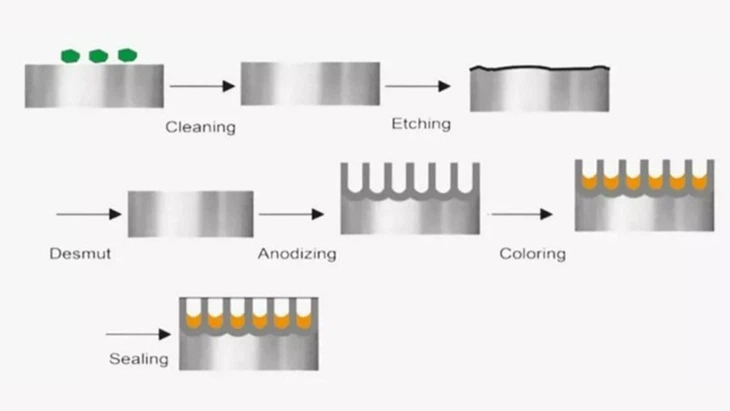
1, Preparation and Cleaning
First, a uniform and smooth surface is essential for the application of the anodized layer. You can achieve this through mechanical treatment and chemical cleaning. Mechanical surface treatment techniques such as grinding, bead blasting, lapping and polishing remove surface irregularities and defects. Whereas alkaline or acid cleaning removes grease, oil, dirt and any other contaminants, followed by rinsing with deionized water to remove residual cleaning agents. Therefore, further cleaning etching can be done to peel off the thin surface layer and form a uniform matte effect.
2, Electrochemical Process
Next, the part to be anodized (let's say metal "M") becomes the anode and other highly conductive metal becomes the cathode, both of which are immersed in an electrolytic cell. When current flows through this electrolytic unit, the anode oxidizes and loses electrons.
Oxidation;
Metal (M) → M³⁺
Next, the metal ions react with the oxygen ions that migrate towards them due to their positive charge. Here, the O²⁻ comes from the dissociation of the electrolyte. They react with the metal ions at the anode to form a solid metal oxide layer.
3, Anodizing Tanks and Reactions
Sulfuric acid, chromium, phosphorus and other anodizing tanks hold the molds to give the desired color appearance. Common methods of applying color in anodized parts are as follows:
• Dyeing: The porous layer absorbs the dye and a wide range of colors is achieved by dipping the part into the dye bath.
• Electrolytic coloring: Metal salts are electrochemically deposited into the pores of the layer, resulting in a long-lasting, non-fading color.
• Integral coloring: The color is incorporated directly into the oxide layer. Typically, it produces darker shades such as bronze or black.
4, Sealing Methods
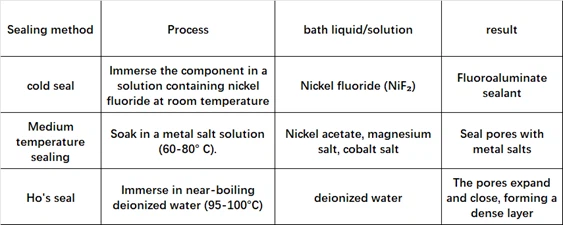
We simply say that the anodizing process produces dye on the surface pores. Here, sealing is essential to avoid the risk of corrosion, scratches and stain formation due to these pores. If the sealing is poor or missing, the porous metal oxide layer will accumulate dust and debris.
You can seal the anodized surface using different techniques, cold sealing, medium temperature sealing and heat sealing.
Types of Anodizing
There are four types of anodizing processes based on the acid bath type and thickness capabilities. They are known as: Type I, Type II, Type II, and Phosphoric Acid Anodizing.
1, Chromic Acid Anodizing (Type I)
Type I or chromic acid anodizing is ideal if you need a thin layer, especially for decorative and some functional uses. However, it can mimic the performance of Type II or hard coating after sealing. Meanwhile, the thickness of the layer ranges from 0.00002"-0.0001".
2, Sulfuric Acid Anodizing (Type II)
This is the most common type and uses sulfuric acid as an electrochemical medium to form the oxide layer. Sulfuric acid anodizing uses a solution with a concentration of 15-20%. It forms a thicker oxide layer than Type I and is used for a wide range of applications. The thickness ranges from 0.0001"-0.001". In addition, Type II anodizing offers high corrosion and wear resistance and is available in a variety of color options.
3, Hard Anodizing (Type III)
Type III is the densest and strongest type and is suitable for thicker oxide layers on the surface. Therefore, it is well suited for harsh and chemical environments. Thickness can range from 0.0005" to 0.006"Hard anodizing is mainly applied to high performance and low friction parts. The hard anodizing method can use chromic acid, sulfuric acid or oxalic acid as the electrolyte.
4, Phosphoric Acid Anodizing
It is primarily a surface treatment rather than a comprehensive anti-corrosion or wear treatment. Phosphoric acid anodizing uses a phosphoric acid solution with a concentration of 15-30%. Unlike the other types, it forms a very thin and porous oxide layer (< 0.0001 inch). It is well suited for the application of further adhesives or primers.
The following table summarizes the four anodizing types mentioned above.

Anodizing colors and their properties
The anodized surface has pores, they can absorb dyes of various colors, and coloring closes these pores and makes it durable. When the type of electrolyte and other process parameters are different, anodized surfaces can have different appearances and properties. Clear, bright, brushed, and dyed are some of the specific types. Each anodized surface has a specific appearance and properties.

In addition, the type of metal or alloy, electrolyte, current and voltage settings, and thickness also affect aluminum anodizing colors (colors without the use of dyes).
The table below highlights their properties.

Applications of Anodized Metals
The anodizing process is widely used on aluminum, zinc, magnesium, titanium, and other non-ferrous metals and alloys. It can finish these materials, no matter how they are manufactured, such as CNC machining, sheet metal, extrusion, or any other method. Let's discuss the applications of anodized metals with specific examples across industries.
1, Anodized Aluminum

You can anodize aluminum alloys from 1000 to 7000 series (except 3 and 4000 series). Aluminum anodizing layer not only gives them customized color and aesthetics, but also improves their resistance to corrosion, wear and scratches. Here are some application examples.
- Automotive parts such as wheel covers, fuel tank caps, engine covers, trims, and control panels.
- Lightweight aerospace parts such as skin panels, structural parts, fasteners, cabin interior items, etc.
- Home appliances and kitchenware.
- Electronic, electrical housings.
- Medical device housings, scalpel handles, sterilization tray handles, etc.
2, Anodized Magnesium

Magnesium is a light metal with an excellent strength-to-weight ratio. Anodizing is an ideal primer for magnesium if further coating is required. At the same time, a hard anodized coating (followed by sealing) can make magnesium parts corrosion-resistant. Here are some application examples.
- Bicycle frame components
- Vehicle battery housings
- High-performance tools and hardware
- Drone, satellite and aircraft components
3, Anodized Zinc

Zinc itself has wear and corrosion resistance properties, and anodizing can further improve these properties and extend the service life of manufactured parts. The oxide layer on the surface of anodized zinc contains phosphates and chromates. Here are some application examples.
- Automotive fasteners, aircraft anodized screws, fuel system parts and other small mechanical parts.
- Nuts, bolts, pipe fittings, building hardware, decorative items and lighting fixtures.
- Electronic housings, tool handles, furniture hardware, etc.
4,Anodized Titanium

Titanium is a high-performance engineering material, it is used in aerospace, medical, defense and other industries. We mainly use Type 2 and Type 3 methods for Titanium. Vivid rainbow colors can be produced in titanium without the need for dyes. Therefore, they are biocompatible and also suitable for various medical uses. Here are some application examples.
- Aerospace fasteners, hydraulic system components, structural housings, etc.
- Medical parts (e.g. hip replacements, dental implants) and surgical instruments
- Automotive connecting rods and muffler components
- Watch cases and bracelets
- Eyeglass frames
- Golf clubs, bicycle parts, etc.