

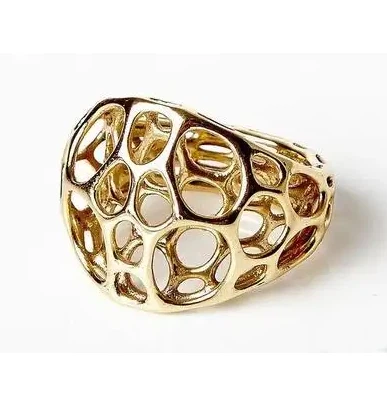


Products Description
We build a brass component with a tolerance of ± 0.05 mm (less than half the diameter of a human hair) for critical parts such as bearing positions or sealing surfaces. Traditional CNC machining in such tasks often require multiple clamping, error accumulation layer by layer. And 3D printing offers advantages from the first layer: layer-by-layer melting of brass powder (each layer is just 20 microns, thinner than copy paper) by 200-400W dynamically modulated lasers, the energy control is optimized according to the high reflection characteristics of brass, and the direct forming accuracy can reach ± 0.1 mm. But that's just the starting point-for critical functional surfaces, we used a hybrid manufacturing strategy: five-axis CNC post-processing to improve local accuracy to ± 0.05 mm, and full-scale verification with a CMM and white-light interferometer. Last year, the system helped a defense supplier reduce rejection rates for high-pressure valve assemblies from 35 percent to 2 percent without the need for expensive custom tooling
The patented flexible abrasive flow process can polish an internal channel with a depth-to-diameter ratio of 10:1 and a diameter of just 0.8 mm (think cooling channels for racing engine parts) , reducing the inner wall roughness from RA12 μm to 3.2 μm. What's more, we keep the 0.1 mm design texture intact during the polishing process, whether it's the non-slip texture of the tool grip or the corporate logo on the architectural hardware. Salt spray tests show that the corrosion resistance time of the treated parts exceeds 500 hours (ASTM B117 standard) , making it ideal for marine and automotive applications.
While simple orders at the 100-piece level may cost as much as CNC, complex structures can be a game changer: parts with internal lattices or conformal cooling channels can be 3D printed for 20-50% less. Customers often find hidden value -- one aerospace customer combined 17 brazed CNC parts into a single 3d-printed fuel nozzle, reducing weight by 25% while reducing costs by 52%
We have 10 industrial printers running in parallel and can deliver samples with surface treatment in 72 hours and 500 + small parts in 5-7 days. In an emergency? Our 24-hour express service helped an electric vehicle start-up complete testing three weeks early -- it took 28 days for a traditional CNC vendor to quote a sensor case with a 0.5 mm internal helical airway.
3d printing brass parts, with their excellent electrical and thermal conductivity and corrosion resistance, in a number of industries show a wide range of applications for the electronics and electrical industry, aerospace and automotive, manufacturing, medical and other industries
Ready to turn complexity into opportunity? Apply for risk-free samples-the future of precision manufacturing, without waiting for tomorrow.r
| Product Name | 3D Printing Brass Parts |
| Place of Origin | China |
| Processing Type | 3D Printing |
| Tolerance | as per customers' requirement. |
| Surface Treatment/Finish | Deburring, Heat treatment, surface polishing, etc |
| Drawing format | 2D/3D/CAD/STEP/PDF |
| Color | Customized Color |
| Industry Of Use | Used in metallurgy, automobile, aero, chemical, ship hardware, and other industries |
| Lead-time | 3 days~10 days about sample |
| Price Terms: | EXW /FOB/CFR/CIF Shanghai or any other airport or seaport, China |
| Inspection |
In-house or third party, all the products are strictly inspected by skilled QC |
| Service Type: | OEM & ODM |
Using 3D printed brass parts
Parts with complex geometries;
Prototyping and functional verification;
Small batch customization and personalized production;
Complex internal passageway or cooling system;
Parts repair and replacement;
Low cost and low volume production;
Special material performance requirements;
High precision demand in the aerospace and automotive fields.



Alec modle Factory 3D printing capabilities
Here are the 3D printing manufacturing capabilities of our Alec model factory:

FAQ
1. can brass be used directly for 3D printing?
A:
Brass (a copper-zinc alloy) is generally not directly used in conventional plastic 3D printing technologies such as FDM or SLA. But it can be done using the following metal 3d printing techniques:
DMLS (Direct metal laser sintering) : formed using brass powder by layer-by-layer laser melting.
Binder Jetting: the use of brass powder in combination with a Binder followed by sintering and penetration (e. g. , impregnation of a low melting point metal) .
METAL FDM: uses brass-filled wire that needs to be debinded and sintered after printing.
Note: Brass Powder or wire must be special 3D printing material, conventional industrial brass may not be applicable.
2. What is the surface quality of 3D printed brass parts?
A:
Direct metal printing (DMLS-RRB- : rough surface (similar to sand casting) , need post-processing (such as polishing, sandblasting) to improve the finish.
Binder Jetting: high surface accuracy, but still need sintering post-treatment.
METAL FDM: the surface of the printed part has obvious lamination, which needs to be machined or chemically polished.
3. What are the technical problems encountered when printing brass?
A:
Thermal deformation: brass has high thermal conductivity, fast cooling, easy to cause residual stress or warping, need to optimize the support structure and printing parameters.
Porosity: incomplete melting powder may produce internal pores, need to adjust the laser power and scanning speed.
Oxidation risk: the printing process should be inert gas (such as argon) protection, to prevent metal oxidation.
4. What are the mechanical properties of 3d-printed brass? Contrast with traditional machined parts?
A:
Strength: the tensile strength of printed brass is about 200-300 MPa, close to cast brass but lower than forged or machined parts.
Density: DMLS parts density can reach more than 99% , close to the solid material.
Ductility: the printed parts may be brittle due to internal stress and need to be improved by heat treatment (e. g. annealing) .
5. Is post-processing required? What are the common post-treatment processes?
A:
Mandatory post-processing:
Support Removal: remove the support structure from printing.
Heat treatment: eliminate residual stress, improve mechanical properties.
Surface treatment: sandblasting, polishing, electroplating (e. g. nickel plating) to improve appearance and corrosion resistance.
Optional post-processing:
Machining: finishing of critical dimensions (e. g. , threaded holes) .
What is the cost of 6.3 D printed brass?
A:
Material cost: the price of brass powder is higher (about100−200/kg) , metalsFDMWire ischeaper(about100-200/kg) , metal FDM wire is cheaper (about 50-100/kg) .
Equipment costs: metal 3D printers are expensive (DMLS equipment starts at about $500,000) .
Suitable scenario: small batch of complex structures (e. g. radiators, custom joints) or prototype verification, not large batch of simple parts.
6. Environmental Protection and safety
A:
Metal dust: the printing process should be equipped with dust removal system to prevent inhalation of harmful particles.
Waste Recycling: unmelted powder can be recycled, but avoid contamination.
Energy consumption: metal 3d printing consumes a lot of energy and needs to balance the needs of environmental protection.
7 What certifications do your brass materials hold?
- Our brass powders and wires comply with ISO 9001, ASTM B117, and RoHS/REACH standards.
Hot Tags: 3d printing brass parts, China 3d printing brass parts manufacturers, suppliers, factory, RESIN 3D PRINTING, CNC Milling Parts, Injection Molding, CNC Machined Humidifier Mockup, High Strength 3D Printing Pa12, hollow metal 3d printing components